Cranking and Post Start Fuel
Crank Fuel Table
During cranking, engine speed is low and fuel atomisation is poor. Additional fuel is required to compensate for fuel condensation on intake and cylinder surfaces and to ensure a combustible air-fuel mixture.
Cranking fuel is calibrated using one or two three-dimensional Cranking Fuel Tables. Each table allows the amount of fuel delivered during the cranking injection event to be varied over two configurable operating axes, providing precise control over cranking fuel under different starting conditions.
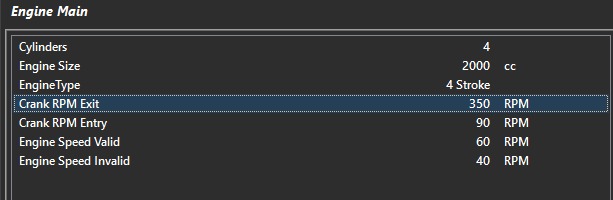
The cranking threshold is defined when the engine speed is below the configured Crank Exit RPM setting.
The Crank Fuel Table is typically configured as a function of coolant temperature and firing events ; the colder engine temperatures requiring greater fuel enrichment.
Fuel from this table is applied continuously while the engine remains in the cranking state.
🔧 Tuning Guidelines
- Increase fuel values if the engine struggles to fire or requires excessive cranking time.
- Decrease fuel values if the engine exhibits signs of flooding.
- Cold temperature regions generally require significantly more fuel than warm temperature regions.
Post-Start Fuel Table
The Post-Start Fuel Table provides temporary fuel enrichment immediately after the engine transitions from cranking to running.
When engine speed exceeds the configured Crank Exit RPM, the ECU exits the cranking state and begins applying the Post-Start Fuel Table. This additional fuel helps stabilise combustion during the first few seconds of engine operation while fuel films and air-fuel mixture conditions settle.
The Post-Start Fuel Table is typically configured as a function of coolant temperature, with colder engine temperatures requiring greater enrichment.
Post-start fuel compensation gradually decays to zero over a user-configurable period, allowing a smooth transition to normal fuel calculations.
🔧 Tuning Guidelines
- Increase fuel values if the engine starts successfully but immediately stumbles, misfires, or stalls.
- Decrease fuel values if the engine starts cleanly but runs excessively rich following start-up.
- Ensure the post-start decay period is long enough to maintain stable combustion, particularly during cold starts.
ℹ️ Crank Exit RPM
The Crank Exit RPM setting defines the engine speed at which the ECU transitions from the Crank Fuel Table to the Post-Start Fuel Table.
Once engine speed exceeds the configured Crank Exit RPM, the engine is considered to be running and post-start fueling becomes active.
Note: Crank Exit RPM is a global ECU setting and may also be used by other ECU functions to determine whether the engine is in a cranking or running state.
Setting Location: Config -> Engine Setup -> Cranking RPM Entry/Exit
Starting Fuel Table Control
See here for more information: Starting Fuel Table Control