Torque Limit Strategies
Torque Reduction Strategy Priority
The ECU provides five Torque Reduction Strategy (Strat Modes). Each Strat Mode has three configurable priority levels that define the preferred order in which the available torque reduction methods are used.
Functions throughout the ECU that request torque reduction can select which Strat Mode to use. For example, Launch Control and Traction Control can each be configured to use a specific Strat Mode.
Each Torque Reduction Strategy (Strat Mode) can use a combination of three torque reduction methods:
| Priority | Torque Reduction Method |
|---|---|
| 0 | Throttle Area |
| 1 | Ignition Retard |
| 2 | Fuel / Ignition Cutting |
Three priority levels are available to determine the preferred order in which these methods are used to achieve the requested torque target.
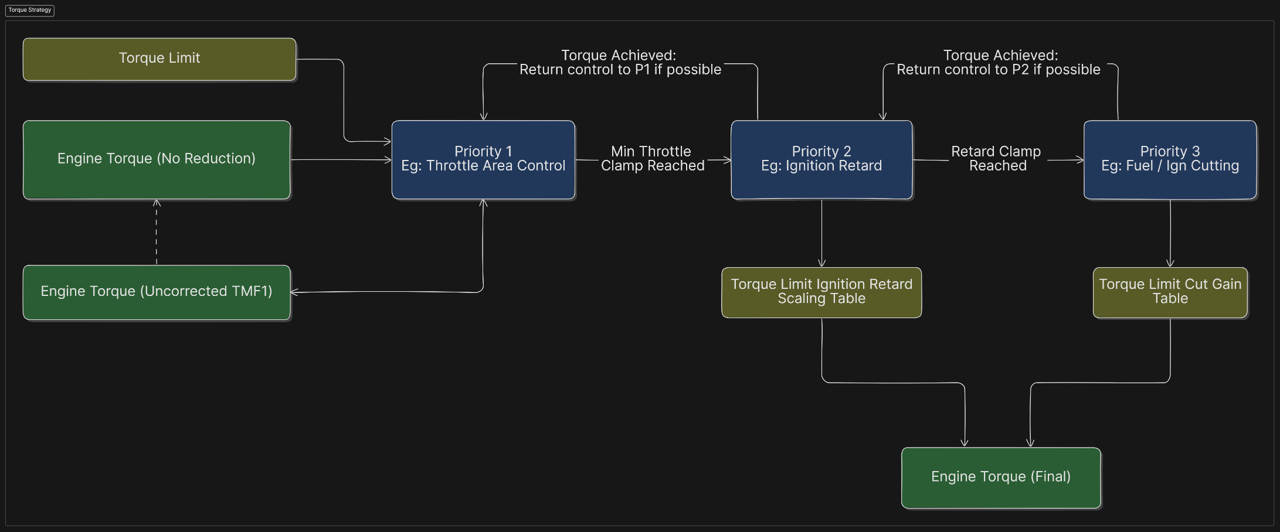
The highest priority method is always used first. If it cannot achieve the requested torque target, the ECU will use the next priority method. This can occur when the selected method reaches a configured clamp or when the required change in throttle air mass takes time to occur. (ie Priority 2 can help reduce torque until Priority 1 method reaches its target)
This priority system is particularly useful during long or sustained Torque Limit conditions, allowing the ECU to use the preferred torque reduction method while automatically using additional methods when required.
Example:
The following priority is configured:
- Priority 1: Throttle Area
- Priority 2: Ignition Retard
- Priority 3: Fuel / Ignition Cutting
- Ignition Retard Maximum Clamp: 15°
When the Torque Limit becomes active, the ECU begins transitioning the Throttle Area towards the position calculated to achieve the requested torque target.
During this transition, the throttle air mass does not change instantaneously, so the requested torque target may not initially be achieved. The ECU therefore uses Priority 2 and applies the calculated Ignition Retard required to achieve the torque target.
If the torque target is still not achieved and the Ignition Retard reaches the configured 15° maximum clamp, the ECU moves to Priority 3 and applies Fuel / Ignition Cutting to complete the required torque reduction.
As the throttle area continues to transition and provides sufficient torque reduction, the ECU progressively removes the Ignition Retard. Once the throttle area can independently sustain the requested torque target, no additional torque reduction method is required.
This allows the ECU to use the preferred torque reduction method whenever possible while automatically applying additional methods when required to achieve the requested torque target.
Strat Mode Torque Reduction Clamps
Each torque reduction method has a configurable clamp that limits the maximum amount of reduction that method can provide. If the requested torque target cannot be achieved and the configured clamp is reached, the ECU moves to the next priority level.
Throttle Area – The Throttle Area Minimum Clamp Table defines the minimum throttle area that can be requested. If the requested torque target cannot be achieved and the minimum throttle area is reached, the ECU moves to the next priority.
Ignition Retard – The Ignition Retard Maximum Clamp Table defines the maximum amount of ignition retard that can be applied. If the requested torque target cannot be achieved and the maximum retard is reached, the ECU moves to the next priority.
Fuel / Ignition Cutting – The Engine Cut Maximum Clamp Table defines the maximum amount of engine cut that can be applied. If the requested torque target cannot be achieved and the maximum cut is reached, the ECU moves to the next priority.