Clutch Capacity Adaption
The Clutch Model and engine inertia value will control the majority of the clutch torque applied during a shift. During a shift, the closed loop PID algorithm will make adjustments to the final clutch torque to try and keep the slip curve on target. After a shift, as long as the conditions are met, the Clutch Capacity Adaption system will look at the previous shift’s closed loop output and make small adjustments to the relevant clutch’s Learned Capacity Scaler.
The settings are under Clutches > Clutch Learning > Clutch Capacity Adaption.
How It Works
During the Inertial Sync Phase, the oncoming clutch is given the torque the model says it needs (the Oncoming Clutch Torque Split runtime), plus whatever the shift closed loop control adds to keep the slip on target. If the clutch model is exactly right, the closed loop has nothing to add.
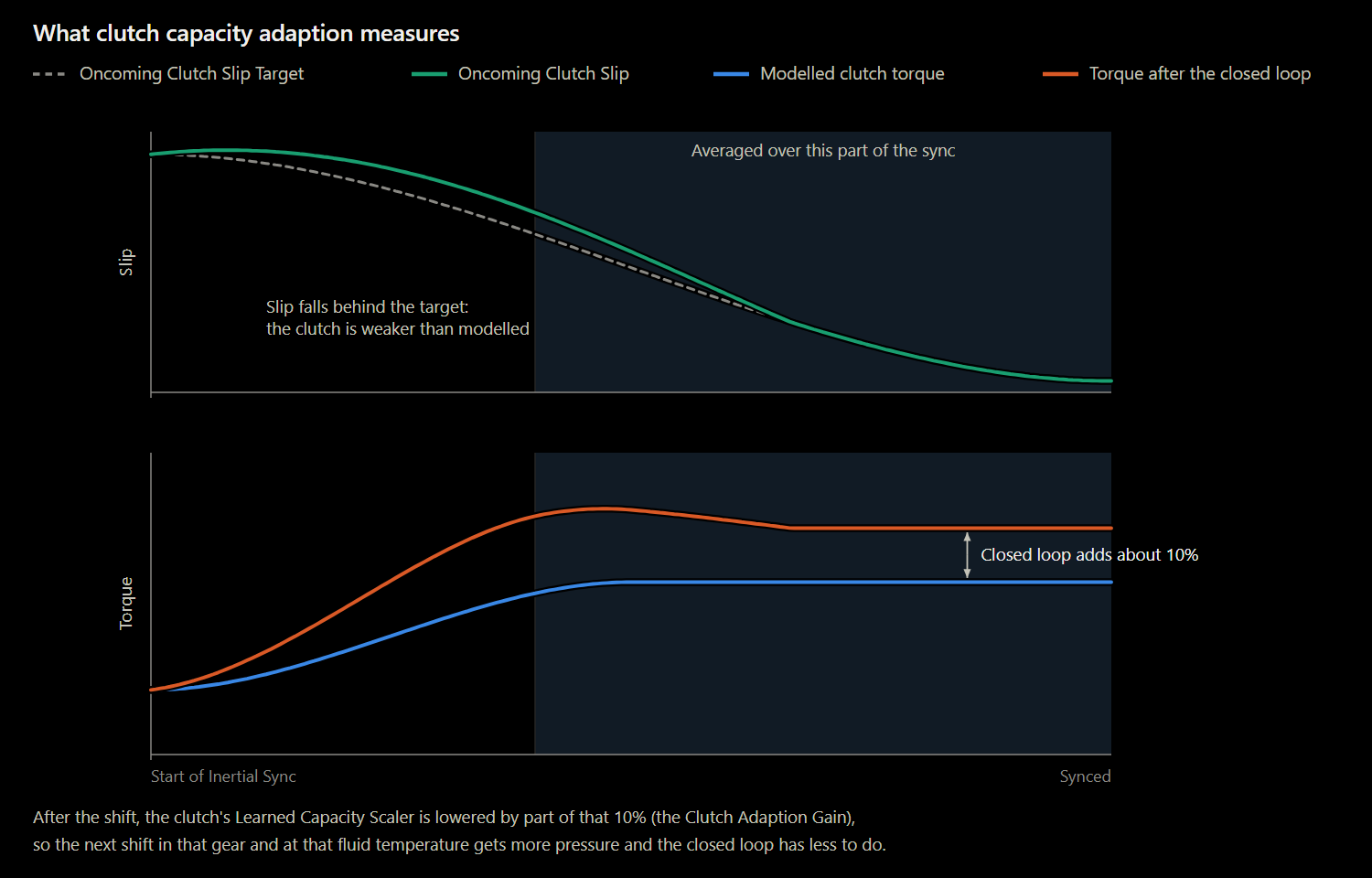
A clutch that is weaker than modelled. The closed loop has to add torque to keep the slip on target.
After the shift, the TCM works out how much the closed loop added over the later part of the sync, as a percentage of the modelled torque:
- The closed loop added torque: the clutch holds less than the model says. Its Learned Capacity Scaler is lowered, so more pressure is applied next time.
- The closed loop took away torque: the clutch holds more than the model says. Its Learned Capacity Scaler is raised, so less pressure is applied next time.
Only part of the error is corrected after each shift, set by the Clutch Adaption Gain, so the scaler settles over a number of shifts rather than chasing any one of them.
The correction goes into the clutch’s Learned Capacity Scaler table, in the cells either side of the current transmission fluid temperature and in the row for the gear being shifted into. Cells that haven’t learned much yet take a bigger share of a correction than cells that have. Part of every correction also goes to the cells in that row that haven’t been learned yet, since most clutch errors (plate count, wear, friction) don’t depend on temperature, so those cells start from a better value than 100%.
Adaption learns from the shift closed loop control, so the Up Shift Closed Loop Control and Down Shift Closed Loop Control gains must be set up. With no closed loop output, there is nothing to learn from.
Which Shifts Are Used
Each clutch learns from the shifts where it is the oncoming clutch. If the clutch comes on during an up shift from one gear to the next, it learns from up shifts only. Otherwise it learns from down shifts.
A shift is only used when:
- Both the old and new gears are forward gears.
- It isn’t a rev matched down shift, and Clutch By Wire wasn’t active.
- The slip reached sync before the Inertial Sync phase ran out of time.
- The modelled oncoming clutch torque stayed between the Clutch Adaption Torque Min and Clutch Adaption Torque Max for the whole Inertial Sync phase, and didn’t vary by more than the Clutch Adaption Torque Slope Max.
- Any up shift torque reduction cut the engine torque by no more than the Clutch Adaption Max Torque Intervention.
- Enough of the sync gave a usable measurement.
The Clutch Adaption Status runtime shows what happened after each shift, for about half a second before it goes back to Standby. Log it to see the result of every shift. Shifts that a clutch never learns from (for example a down shift, for a clutch that learns from up shifts) leave it at Standby.
| Status | Meaning |
|---|---|
| Off | Clutch Adaption is turned off, or the Clutch Adaption Gain is 0. |
| Standby | Waiting for a shift. |
| Learning - Clutch A (B, C…) | The last shift was used to update that clutch’s Learned Capacity Scaler. |
| Lockout - Torque Low | The modelled torque went below the Clutch Adaption Torque Min. |
| Lockout - Torque High | The modelled torque went above the Clutch Adaption Torque Max. |
| Lockout - Torque Slope High | The modelled torque varied by more than the Clutch Adaption Torque Slope Max. |
| Lockout - Not Enough Data | Too little of the sync gave a usable measurement, for example a very short sync. |
| Lockout - Clutch By Wire | Clutch By Wire was active during the shift. |
| Lockout - No Sync | The Inertial Sync phase ran out of time before the slip reached sync. |
| Lockout - Torque Intervention | An up shift torque reduction cut the engine torque by more than the Clutch Adaption Max Torque Intervention. |
Settings
| Setting | Description |
|---|---|
| Clutch Adaption | Turns Clutch Capacity Adaption on. |
| Clutch Adaption Torque Min | Shifts where the modelled oncoming clutch torque goes below this aren’t used. At low torque, small torque errors are large percentages. |
| Clutch Adaption Torque Max | Shifts where the modelled oncoming clutch torque goes above this aren’t used. |
| Clutch Adaption Torque Slope Max | Shifts where the modelled oncoming clutch torque varies by more than this during the Inertial Sync phase aren’t used, for example a throttle change mid shift. |
| Clutch Adaption Max Torque Intervention | Shifts where an up shift torque reduction actually cut the engine torque by more than this percentage of Engine Torque (Available) aren’t used, as the result then depends on the accuracy of the torque reduction. |
| Clutch Adaption Gain | How much of each shift’s measured error is corrected. A lower value learns more slowly but is less affected by any one shift. 0 turns adaption off. |
| Clutch Adaption Deadband (+/-) | Errors smaller than this are ignored. |
| Clutch Adaption Min Clamp | The lowest value the Learned Capacity Scaler can learn. |
| Clutch Adaption Max Clamp | The highest value the Learned Capacity Scaler can learn. |
The torque settings are compared with the modelled oncoming clutch torque, which is the Oncoming Clutch Torque Split runtime during the Inertial Sync phase.
Clutch Learned Capacity Scaler Tables
Each Clutch has a Learned Capacity Scaler Table, for example Clutch A Learned Capacity Scaler. It scales the clutch’s friction coefficient in the Clutch Model, so it changes the clutch’s pressure everywhere its pressure is torque modelled, not just during shifts.
- A value of 100% means no correction is applied.
Clamping pressure remains unchanged. - A value below 100% suggests that the actual clutch capacity is less than described by the clutch geometry model.
More clamping pressure will be applied. - A value above 100% suggests that the actual clutch capacity is higher than described by the clutch geometry model.
Less clamping pressure will be applied.
The Clutch A Learned Capacity Correction runtime shows the value in use.
These tables are stored automatically when the TCM shuts down. If the TCM loses power without shutting down, anything learned since it last shut down is lost.
Uploading a cal file will NOT overwrite the tables.
To reset every clutch’s table to 100%, use Device > Clear Clutch Capacity Learning.
Important
Clutch Learned Capacity Scaler Table’s have strict axis requirements:
- X Axis: MUST be Transmission Fluid Temperature.
- Y Axis: MUST be Gear or Off.
- Z Axis: Not used.
If the X axis is anything else, the TCM resets the table to a Transmission Fluid Temperature axis with no Y axis, and clears it, when it starts. With a Y axis other than Gear, only the table’s first row is learned.
With Gear on the Y axis, each gear learns separately. This is recommended on multi-clutch transmissions: the same clutch can carry a very different share of the torque in different gears, and a row per gear also takes up any error in that gear’s Clutch Gear Load Factor. Give every forward gear its own row, or a gear without one learns into another gear’s row.
Tuning Tips
- Get the clutch model and the shift closed loop control working well before turning adaption on. Adaption is for tidying up small errors, wear and clutch to clutch variation, not for making up for a model that is well off.
- A table that keeps heading towards the Min or Max Clamp points to a problem in the model, such as a diameter, plate count or friction coefficient.
- If one gear’s row is consistently well away from the others, check that gear’s Clutch Gear Load Factor.
- Clear the learning after changing the clutch model or fitting new clutches, so the tables start again from 100%.